Best Air Purifiers (2026): CADR First, Quiet Second, Filter Costs Always
Air purifiers aren’t magic — they’re fans plus filters. If you buy by the right numbers (CADR/ACH) and don’t get tricked by loud ‘turbo’ modes or pricey filters, you can meaningfully cut dust, pollen, and smoke in a single room.
If you’ve ever bought an air purifier that technically “covers 60m²” but still leaves you sneezing, you’ve met the industry’s favourite trick:
- the box is sized for optimistic conditions
- your room is real (doors open, pets shedding, smoke events, cooking)
- and you don’t actually run it on “jet engine” mode 24/7
This guide is about buying air cleaning that you’ll actually use.
SolderMag Take: treat an air purifier like a room-scale benchmark (CADR/ACH), not a gadget
A good air purifier is basically:
- a fan (airflow)
- a particle filter (usually HEPA)
- optionally a carbon filter (odours/VOCs, with caveats)
So the best buying move is boring:
- size it by CADR / air changes per hour, and
- pick a model you’ll run on a quiet speed,
- then sanity-check filter cost + availability.
Everything else (apps, PM2.5 graphs, “AI auto mode”) is secondary.
What an air purifier is good for (and what it isn’t)
Great for
- pollen / dust / pet dander (particles)
- wildfire smoke (fine particles, if sized correctly)
- reducing “my room feels dusty” maintenance load
Not great for
- fixing a mould problem (you need moisture control + remediation)
- “making stale air fresh” (ventilation is the real tool)
- eliminating all gases/VOCs (carbon can help, but most consumer units are light on sorbent)
EPA’s framing is the right baseline: purifiers and HVAC filters can be a supplement to source control and ventilation — not a replacement.
The 9 things that matter when choosing an air purifier
1) CADR (Clean Air Delivery Rate): the spec that actually predicts performance
CADR is the volume of filtered air delivered, typically with separate scores for smoke, dust, and pollen.
Higher CADR = faster cleaning.
AHAM’s rule of thumb is a useful shortcut:
- CADR should be at least 2/3 of the room area (in ft²), and
- for wildfire smoke, AHAM recommends smoke CADR ≈ room area (ft²).
If your ceilings are high or doors stay open, size up.
2) Air changes per hour (ACH): why “fast” beats “big room” marketing
ACH is “how many times per hour the purifier can deliver clean air to that room.”
Practical targets:
- 2–3 ACH: noticeable but gentle
- 4–5 ACH: the sweet spot for allergies and smoke
- 6+ ACH: aggressive cleaning (often noisy unless you oversize)
A trick that works: buy a purifier rated for a bigger room than yours, then run it on a quieter middle setting to hit your ACH target without the noise penalty.
3) Noise at the speed you’ll actually use
Most people don’t run “turbo” for long. So what matters is:
- noise on medium (your default)
- and whether sleep mode is truly quiet (and doesn’t turn the fan down so far it stops doing anything)
If you’re sensitive to noise, oversizing helps — you can get the same CADR at a lower fan speed.
4) Filter type: HEPA (or ‘HEPA-like’) and what to watch for
For particles, you generally want a true HEPA filter class product (manufacturers label this differently).
What to avoid:
- vague terms like “HEPA-type” / “HEPA-like” without clear performance metrics
- units that rely on “ionization” language as the main cleaning mechanism
5) Filter costs and the subscription trap
Two purifiers can have the same CADR and wildly different ownership cost.
Check:
- replacement interval (months)
- cost per filter set
- whether you can buy filters locally (or you’re stuck importing)
Rule of thumb: if filters are hard to source, the purifier becomes a loud sculpture.
6) Carbon filters: helpful for odours, limited for ‘chemicals’ unless there’s real mass
Carbon can help with:
- cooking smells
- light VOCs
- “new room” odours
But lots of consumer purifiers use thin carbon sheets that saturate quickly.
If odours are your main issue, look for a model with substantial carbon (more weight/volume) — and assume you’ll replace it more often.
7) Beware ‘ozone’ and ozone-adjacent marketing
Some products intentionally generate ozone (or use ionizers that can create byproducts).
EPA’s stance is blunt: ozone is a reactive gas that can harm lungs, and the agency does not certify air cleaning devices.
Simple rule: for an occupied home, prefer mechanical filtration (fan + filter) and skip anything that sells itself as “ozone,” “activated oxygen,” or similar.
8) Placement: airflow is the whole game
You can sabotage a great purifier by shoving it in a corner behind furniture.
Do:
- keep intake/exhaust clear (follow the manual’s clearance guidance)
- put it in the room you’re actually in (bedroom, office)
- close doors/windows when you’re trying to clean fast
9) Smart features: nice-to-have, not a reason to buy
PM sensors can be useful for auto mode, but:
- sensors vary, and
- auto mode often prioritizes “quiet” over “effective.”
If you want reliability, set a manual speed that hits your desired CADR/ACH and treat the app as a remote control.
Quick sizing cheats (real-life)
Bedroom (10–14 m² / ~110–150 ft²)
- Target: quiet, consistent cleaning
- Good goal: 4–5 ACH
- Move: buy a model rated for a small living room, run on medium/sleep
Home office (12–20 m² / ~130–215 ft²)
- Target: fewer allergies + less dust on desks/gear
- Goal: 4–5 ACH
- Bonus: don’t point exhaust straight at your mic (white-noise city)
Living room / open plan
- Hard mode: large volume + air mixing
- Move: either one big unit with high CADR, or two medium units at opposite ends
- Expectation: doors open = performance drops
Wildfire smoke days
- Goal: higher smoke CADR and more runtime
- Move: close up, run higher speed, and consider a second unit for sleeping areas
Common mistakes (and easy fixes)
- Buying by “room size” alone: translate it into CADR/ACH.
- Running only on auto: pick a speed you can tolerate and leave it there.
- Ignoring filter availability: check before you buy the machine.
- Over-trusting carbon claims: thin carbon ≠ heavy gas removal.
- Using an ozone generator in an occupied space: don’t.
Buying checklist (fast)
- Measure room area (and be honest about open doors)
- Choose a target (generally 4–5 ACH)
- Pick a purifier with CADR that supports that at a quiet speed
- Prefer well-defined filtration (HEPA-class + prefilter)
- Price out filters for 12–24 months
- Decide if you actually need carbon (odours) vs particles (HEPA)
- Skip ozone/ionizer-first devices
- Plan placement (clear intake/exhaust)
Our top picks
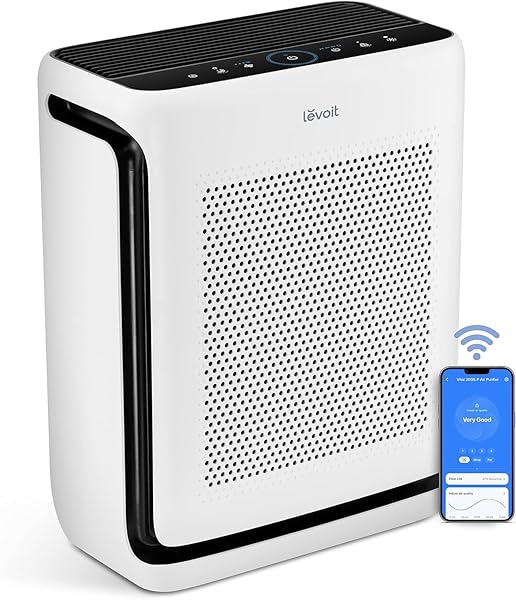 Best overall
Levoit Vital 200S
 Best for large rooms
Coway Airmega ProX
 Best value
Blueair Blue Pure 311i+ Max
 Best budget
Honeywell HPA250B
Sources
- U.S. EPA — Air Cleaners and Air Filters in the Home (selection + limitations; portable air cleaner guidance): https://www.epa.gov/indoor-air-quality-iaq/air-cleaners-and-air-filters-home
- AHAM Verifide — Air Filtration Standards (CADR explanation + 2/3 rule; smoke CADR guidance for wildfire smoke): https://ahamverifide.org/ahams-air-filtration-standards/
- U.S. EPA — Ozone Generators that are Sold as Air Cleaners (ozone health risks; not recommended for occupied spaces): https://www.epa.gov/indoor-air-quality-iaq/ozone-generators-are-sold-air-cleaners